THWS Master’s programme in Managing Global Dynamics: Digital business meets sustainability on the international stage
Engaging with companies in an interactive manner in a dynamic virtual 3D environment: this is what the start-up project TalentVerse enables students in Africa to do. Samia Chelbi, founder of TalentVerse, and the start-up’s chief technology officer gave master’s students on the Managing Global Dynamics course at the THWS Business School of the Technical University of Würzburg-Schweinfurt (THWS) valuable practical insights into the development of a globally scalable, sustainable, digital business model through a live preview and technology demonstration in a guest lecture. From Tunisia, the start-up presented how an EdTech and talent platform is built from the idea to the pilot to international scaling, working with actors such as the United Nations, the African Union, the European Union, and financing partners such as KfW (Kreditanstalt für Wiederaufbau) and partner universities.
State-of-the-art insights
The presentation is part of the Global Digital Entrepreneurship Business Lab run by THWS lecturer Bernd Hanheiser. Entrepreneurship refers in a broader sense to aspects such as business management and entrepreneurial spirit. ‘The guest lecture shows how the Managing Global Dynamics programme introduces students to real innovation projects at an early stage,’ emphasises Prof. Dr. Bolsinger. ‘Our goal is for our students to not only talk about digital sustainability, but to experience first-hand how sustainable platforms are designed, tested and scaled in international ecosystems.’ In this way, the programme underscores its claim to combine scientifically sound analysis with direct application in global transformation processes.
TalentVerse: Case study for global impact platforms
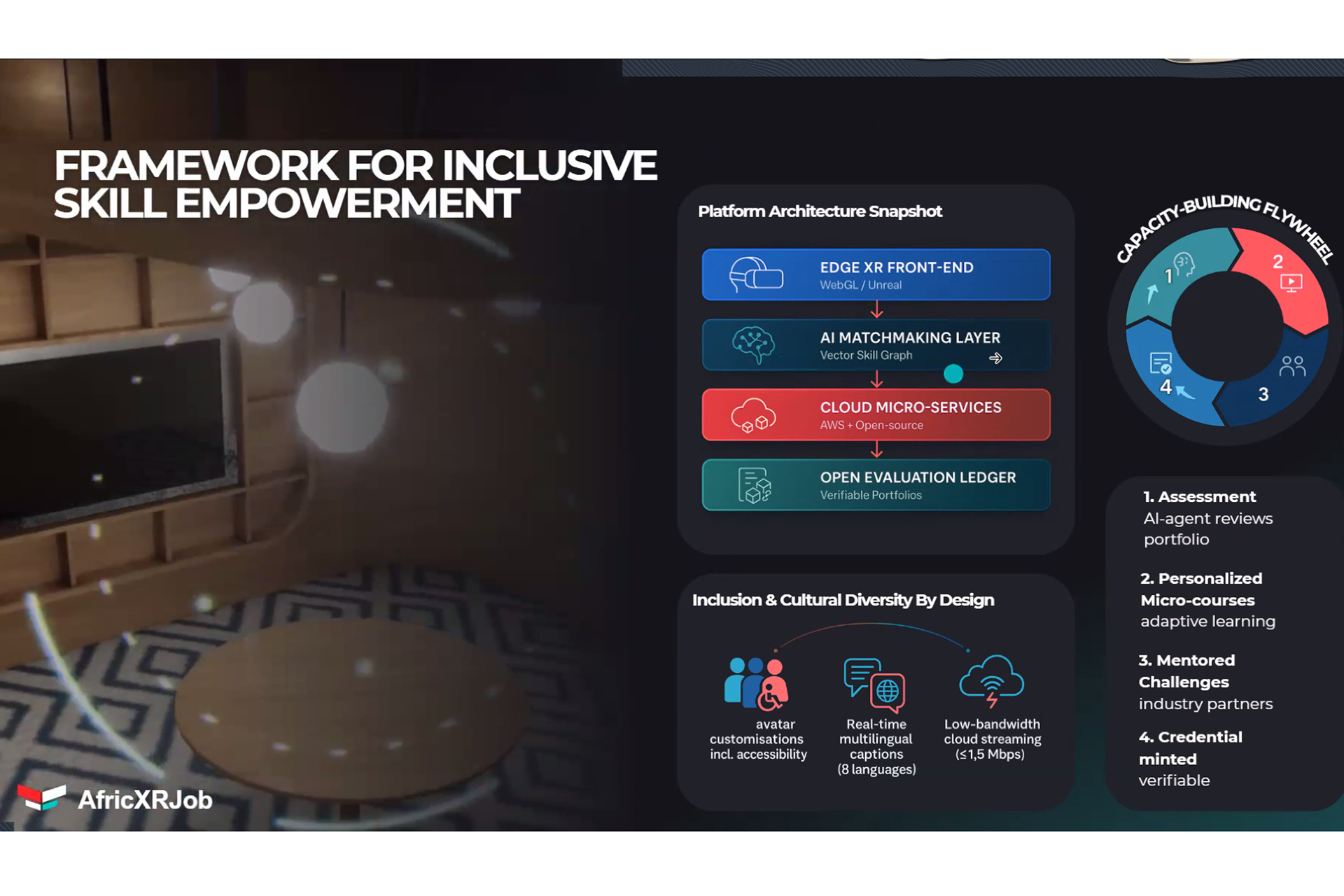
During the virtual meeting, students were given a structured overview of the entire TalentVerse life cycle – from the original idea to the current pilot phase and future scaling scenarios. Samia Chelbi explained key elements of her digital business model, including its positioning as an international EdTech and talent platform and its integration into funding and partner structures on several continents. ‘The live demonstration of the virtual environment clearly showed how TalentVerse brings together education, training and job matching processes in an immersive, game-like platform,’ said Prof. Dr. Bolsinger. Immersive means diving into an environment or experience.
Digital and global
Combining training, job fairs and social interactions to create a unique value-added architecture: The demonstration focused on a functional prototype environment with three core modules: training, job fairs and social activities. Among other things, the students learned about skills evaluations, simulated classrooms for adaptive, microdidactic learning units, co-working spaces, artificial intelligence agents (AI agents), presentation rooms, AI-based matching, and social areas such as interaction zones. ‘This enabled our students to understand how TalentVerse merges learning processes, talent development and sustainable everyday situations into a consistent, digital ecosystem,’ explains Prof. Dr. Bolsinger. Structurally, TalentVerse is differentiated by a global partnership network that aims to enable the development of a transcontinental talent ecosystem. This creates a value-added architecture that is difficult to imitate and is based on international alliances, digital infrastructures and common sustainability goals. In the Master’s programme in Managing Global Dynamics, such best practice examples teach students state-of-the-art approaches to business model differentiation in a digital and sustainable context.
Voices from practice and academia
Lecturer and entrepreneur Bernd Hanheiser, who prepared the session from a didactic perspective, explains the significance of the format: ‘For us, TalentVerse is a test laboratory where we work with students to explore how responsible business models can be developed in an immersive space – with real customer benefits and clear impact metrics.’ Samia Chelbi adds: ‘Working with students from the Managing Global Dynamics programme is crucial for us because it allows us to critically reflect on how a platform like TalentVerse really needs to function in order to reach its target audience.’ Prof. Dr. Bolsinger emphasises: ‘Live demonstrations like this help empower our students to not only analyse global sustainability and digitalisation goals, but also to implement them themselves in internationally networked project teams. This is another reason why students develop their own digital business models, which we examine for real implementation opportunities.’
As part of the Global Digital Entrepreneurship Business Lab, students are not only introduced to the TalentVerse case study, but also work on developing their own innovative digital business models. The limited number of students allows for intensive supervision. Building on their insights into the lifecycle, platform architecture and impact logic of TalentVerse, students analyse opportunities in global digital markets and apply them to their own sustainable, scalable business model designs. ‘We never do dry exercises, but always focus on real market opportunities and options for change in a highly dynamic world! This is the only way our students can get started right away – with their own new company or in existing organisations,’ says Prof. Dr. Bolsinger, explaining the practice-oriented teaching approach in the programme.

THWS students with entrepreneur Samia Chelbi, investor and entrepreneur Bernd Hanheiser (lecturer in the THWS Master’s programme in Managing Global Dynamics) and programme director Prof. Dr. Harald Bolsinger (top centre) (Photo: THWS/Harald Bolsinger)
Managing Global Dynamics :: Technische Hochschule Würzburg-Schweinfurt