
THWS Best Teacher Award 2026: Digital Teaching “Reflective Teaching with AI”
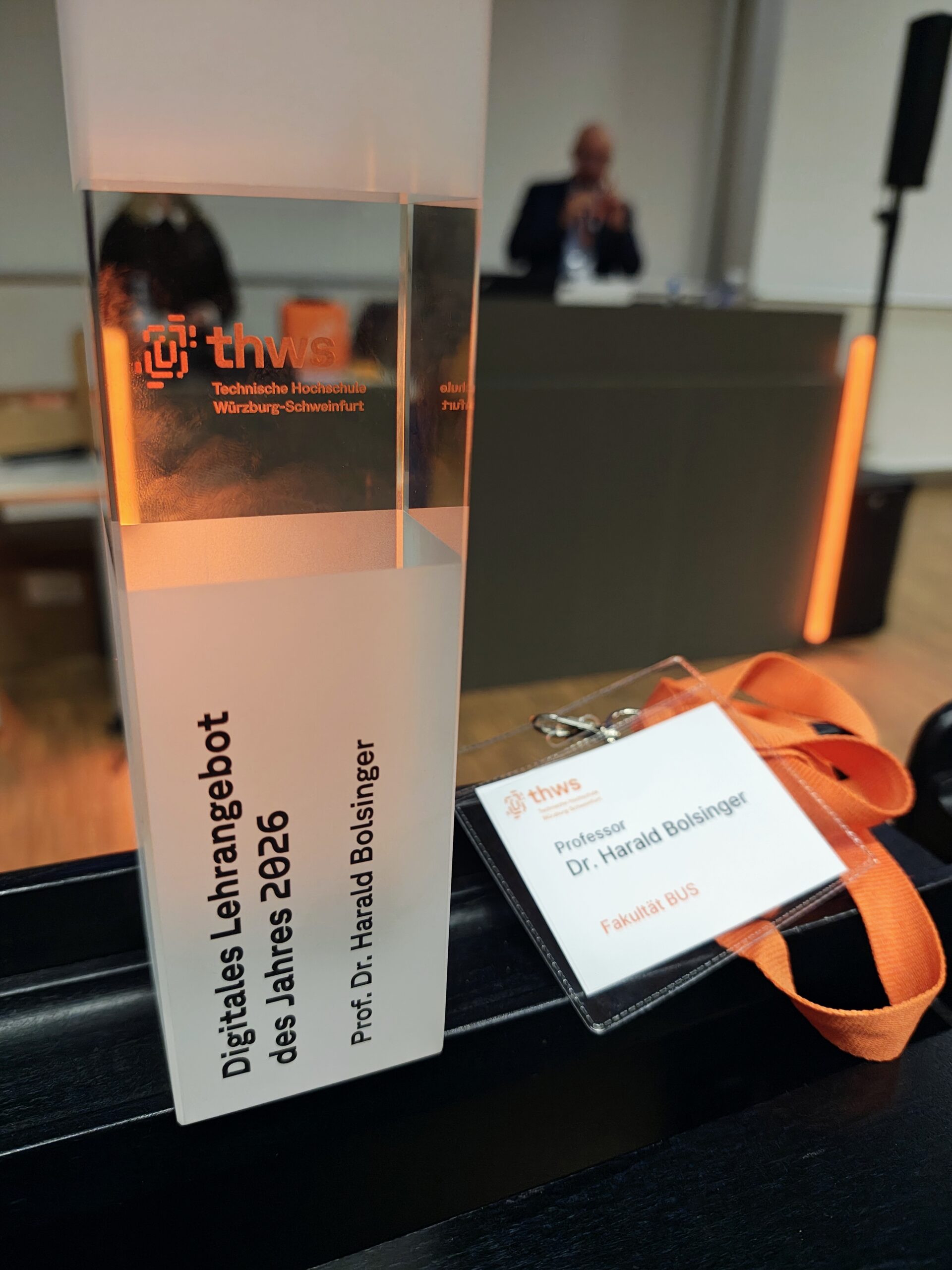 My course “Values-oriented Corporate Communication in the Social Market Economy (Bachelor Media Management)” was awarded the THWS Best Teacher Award 2026 in the category “Digital Teaching”. “Reflective teaching with AI” is once again becoming visible as the “new normal” at our university! Thanks to my university, which not only presented the award but also provides an excellent infrastructure and the freedom for future-proof teaching, which is truly not to be taken for granted! Thanks also to my colleagues, who continue to work tirelessly together on the optimal integration of Future Skills into our THWS Business School!
In its press release dated 26.10.2026, THWS refers to the core content of the laudatory speech by the dean of studies Prof. Dr. Gottschalk, who emphasized that the didactic approach to the topic of AI use would also benefit students at other universities because its didactic reach extends beyond the boundaries of THWS. “Students learn to critically question AI results, recognize biases, verify sources, and make responsible decisions,” said Prof. Dr. Gottschalk. This is the reason, why I have decided to document the whole Idea to be published soon for everyone to read and experiment with…Follow me on linkedin, where I will make that available.
A BIG THANK YOU goes to Timothy Carambat and his team from Mintplex Labs, who developed AnythingLLM – one of the best tools out there for our didactical needs to build AI Future Skills with our Students….
_______________
The decisive criterion for the award is didactic, methodological, and subject-specific excellence. The courses or offerings honored with a teaching award stand out demonstrably and significantly. The nomination was texted as follows: “Colleague Bolsinger has developed a scientifically grounded Future Skills didactics for the interdisciplinary acquisition of AI competencies and for practical implementation. He undertook an unprecedentedly extensive research and self-testing of 40 LLMs, including an examination of licensing conditions and technical requirements for BYOD across all operating system types. To this end, desktop computers, tablets, and mobile phones were tested with various software packages to achieve an optimal, practice-oriented LLM selection and overall configuration for students. In coordination with colleague Warnke from the partner faculty of the relevant degree program, a scientific foundation was established that enables ‘reflexive teaching with AI’ without the danger of cognitive offloading. As a result, in addition to the subject matter, the teaching offering was also substantiated and implemented in a state-of-the-art manner regarding AI. The ‘AI-Introduction Course of THWS’ was integrated as mandatory for all students. Due to its excellence within the faculty, the teaching offering serves as a model for further steps towards integrating AI competencies into various other courses.
The course is didactically excellent because it does not merely convey knowledge, but systematically trains judgment, self-reflection, and responsible action. Students learn not to use AI blindly, but to critically evaluate results, recognize bias, and verify statements using reliable sources. The teaching offering is innovative due to the reflected, rule-governed use of several AI models, the local offline use with AnythingLLM, and the comparative testing of different tools and cultural model contexts. Particularly noteworthy is the long-term cross-faculty collaboration between FAS and FBUS, which does not treat the topic of AI teaching in isolation, but rather approaches it interdisciplinarily and in an application-oriented manner. A complete subject evaluation of the cross-faculty tested teaching concept has already taken place. This subject evaluation was jointly developed by colleagues Bolsinger, Warnke, and Mühling and is intended to be transferred into a cross-faculty long-term study in order to be able to specifically address the effects of AI competency development from a didactic perspective.”