The practice of reflective teaching with AI: Future skills development with offline LLMs.
“The practice of reflective teaching with AI: Future Skills development with offline LLMs.”, in: Practice of Artificial Intelligence in Higher Education, 1(1) 2026, Artikel 2, together with Warnke, S., & Mühling, T., doi.org/10.83397/PAIHE.2026.02
Artificial Intelligence in Higher Education: Between Hype, Resistance, and True Future Skills!
The new journal “Practice of Artificial Intelligence in Higher Education” (PAIHE) has officially launched, featuring the publication of the article “The Practice of Reflective Teaching with AI: Future Skills Development with Offline LLMs”, which broadly outlines the AI-didactics of my courses recently awarded the THWS Teaching Award 2026.
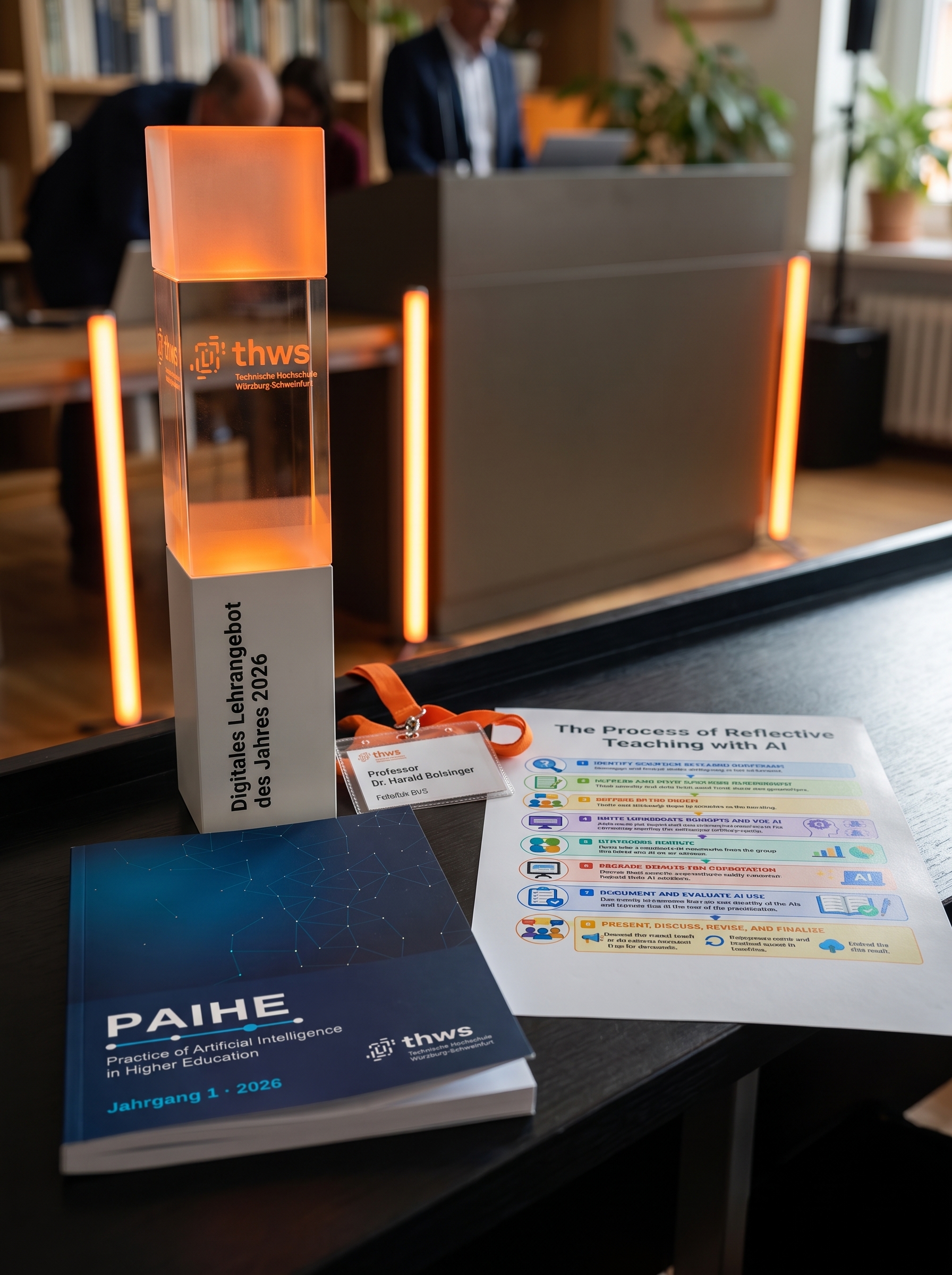
📖 What is the article about? The practice report highlights the teaching concept for values-oriented corporate communication in the Media Management degree program at THWS Business School. At the core of the concept is “Reflective Teaching with AI”:
-💡 Reflection instead of shortcuts: AI serves not as a substitute for thought, but as a friction surface for feedback and a perspective shifter. First comes the student’s own team-based analysis, followed by AI-supported mirroring and enhancement, before being finalized with academic AI and domain expertise.
-💡 Privacy First with Offline LLMs: Students use local, open-source AI models on their own devices (“Technology for Everyone”) to work in a privacy-compliant manner without cloud dependency.
-💡 Understanding for cultural AI perspectives: By systematically comparing different models, students learn to critically question algorithmic bias and differing value systems.
🏆 The best feedback: This teaching format was awarded the best teacher award in the category digital teaching concept of the year 2026 by THWS! The students’ results demonstrated a depth of content and quality that exceeded all previous cohorts, and competence development went fully in the right direction.
🙏 Acknowledgments: A heartfelt thank you goes to my co-authors Sven Warnke and Tanja Mühling for the fantastic collaboration and for driving PAIHE forward together! I would also like to thank THWS for providing the freedom to experiment, my colleagues at THWS Business School, and my students, who engaged with this new teaching setting with immense curiosity, critical thinking, and commitment!